Types of Bearings: A Complete Guide to Bearing Types and Applications
Almost every machine that involves rotation or motion depends on one critical component — the bearing. Although hidden inside equipment, bearings play a vital role in reducing friction, supporting moving parts, improving efficiency, and extending machine life. In this guide, we break down the main types of bearings — from household appliances to heavy industrial machinery — and how each one keeps equipment running smoothly, reliably, and precisely. For background on the underlying mechanics, see this overview of mechanical bearings on Wikipedia.
Key Takeaways
- Bearings reduce friction and enable smooth movement between machine components.
- Different types of bearings are designed for different requirements such as speed, load capacity, and operating conditions.
- Rolling element bearings provide high efficiency and precision, while plain bearings excel in heavy-load applications.
- Selecting the right bearing type improves machine reliability, reduces maintenance costs, and increases service life.
The Challenge: Controlling Friction in Moving Machines
When industries began developing machines with rotating and moving components, engineers faced a major challenge — friction.
Continuous metal-to-metal contact between moving parts created excessive heat, rapid wear, reduced efficiency, and frequent machine failures. As machines became faster and more powerful, these issues became major obstacles to industrial growth.
To overcome this challenge, engineers introduced the bearing — a revolutionary mechanical component designed to reduce friction, support rotating shafts, and provide smooth, accurate, and reliable movement.
Bearings transformed mechanical engineering by replacing harmful sliding friction with controlled rolling or sliding motion, allowing machines to operate faster, longer, and more efficiently.
What Is a Bearing?
A bearing is a precision-engineered mechanical component that supports rotating or moving parts while minimizing friction between surfaces.
It carries loads, reduces wear, improves motion accuracy, and extends the operating life of machinery. Bearings are widely used in automotive systems, industrial equipment, electric motors, aerospace applications, and manufacturing machinery.
The Two Main Bearing Categories
1. Rolling Element Bearings
Rolling element bearings use balls or rollers between the inner and outer rings to reduce friction. Instead of sliding contact, the rolling elements move smoothly along precision-machined raceways.
They are widely used in high-speed, high-efficiency, and precision applications where low friction and reliable operation are required.
Advantages of Rolling Element Bearings
| Advantage | Benefit |
|---|---|
| Low Friction | Reduces power loss and heat generation |
| High Speed | Suitable for fast rotating applications |
| High Efficiency | Improves machine performance |
| Long Life | Provides reliable operation |
| High Precision | Maintains accurate movement |
| Low Noise | Ensures smooth operation |
| Easy Installation | Simple replacement and maintenance |
2. Plain Bearings (Sliding Bearings)
Plain bearings operate through sliding contact between two surfaces without using rolling elements.
They are commonly used in heavy-load, low-speed, and oscillating applications where simplicity, durability, and shock resistance are important.
Advantages of Plain Bearings
| Advantage | Benefit |
|---|---|
| Simple Design | Easy manufacturing and installation |
| High Load Capacity | Handles heavy mechanical loads |
| Compact Size | Requires less installation space |
| Shock Resistant | Performs well under impact loads |
| Low Cost | Economical solution for many applications |
| Quiet Operation | Produces minimal operating noise |
Common Types of Bearings Explained
Ball Bearing
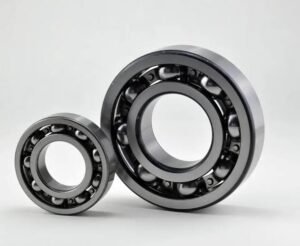
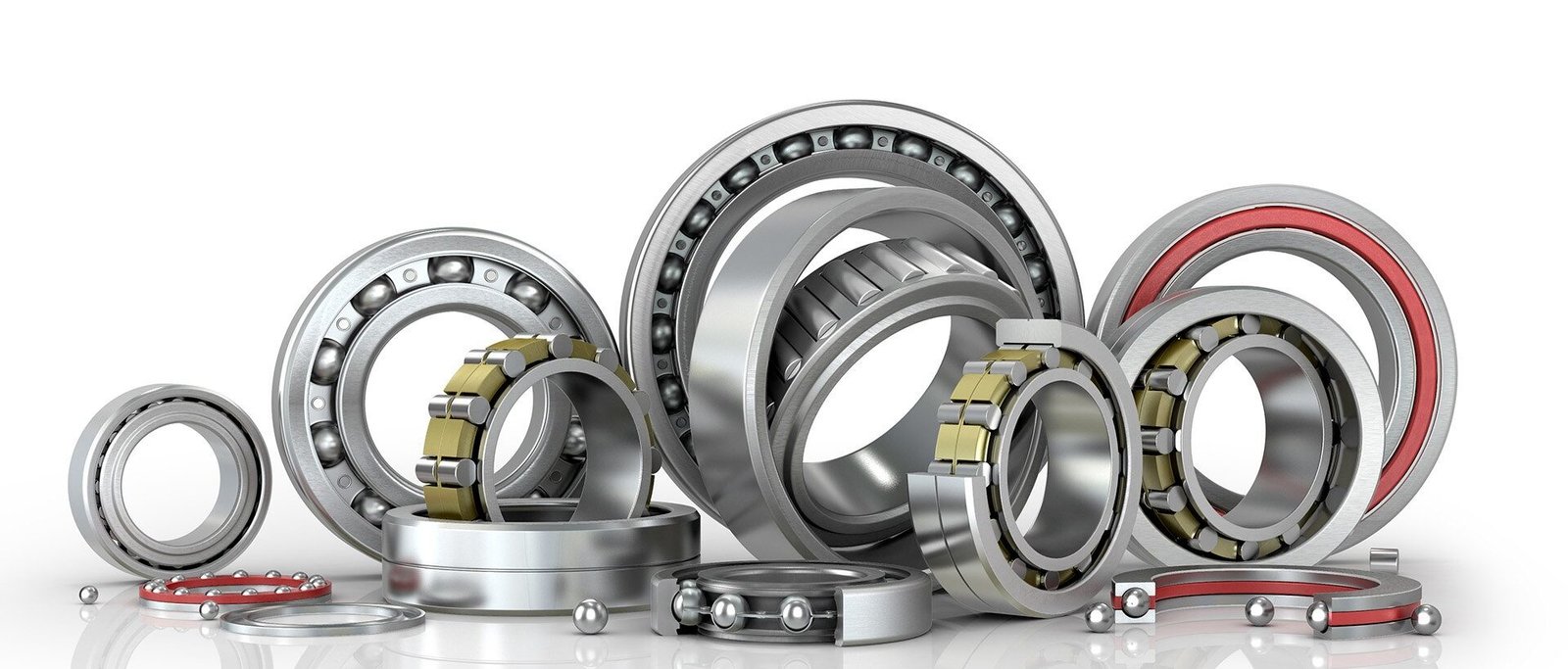
A ball bearing is a rolling-element bearing that uses hardened steel balls positioned between an inner ring and an outer ring. The balls move inside precision-machined raceways, replacing sliding friction with rolling friction and allowing components to rotate smoothly with minimal resistance.
How Does a Ball Bearing Work?
When the shaft rotates, the inner ring rotates along with it while the outer ring remains fixed inside the housing. The steel balls roll between the two raceways instead of sliding, significantly reducing friction, heat generation, and wear.
A cage (retainer) keeps the balls evenly spaced, ensuring smooth rotation, stable operation, and reliable performance even at high speeds.
Components of a Ball Bearing
| Inner Ring | Outer Ring | Steel Balls | Cage (Retainer) | Raceways | Seal or Shield |
Advantages & Limitations of Ball Bearings
| Advantages | Limitations |
|---|---|
| Low Friction | Limited Axial Load Capacity |
| High-Speed Operation | Lower Load Capacity Than Roller Bearings |
| Smooth & Quiet Running | Sensitive to Misalignment |
| Long Service Life | Requires Proper Lubrication |
| High Efficiency | Not Suitable for Heavy Shock Loads |
| Low Maintenance | Not Suitable for Extremely Heavy-Duty Applications |
| Easy Installation | |
| Cost Effective | |
| Standardized Sizes |
Deep Groove Ball Bearing
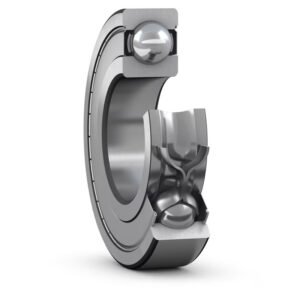
A deep groove ball bearing is one of the most widely used rolling-element bearings. It uses hardened steel balls running inside deep, continuous grooves between the inner and outer rings.
The deep groove design allows it to support radial loads and light axial loads in both directions while providing smooth, quiet, and efficient operation.
How Does a Deep Groove Ball Bearing Work?
The inner ring is mounted on the rotating shaft while the outer ring remains fixed inside the housing. As the shaft rotates, the steel balls roll smoothly inside the raceways, replacing sliding friction with rolling friction.
This reduces heat generation, minimizes wear, and allows machines to operate efficiently for longer periods.
Components of a Deep Groove Ball Bearing
| Inner Ring | Outer Ring | Steel Balls | Cage (Retainer) | Raceways | Seal or Shield |
Deep groove ball bearings are popular because they offer an excellent balance between speed, reliability, cost, and availability. This makes them suitable for applications ranging from electric motors and pumps to automotive systems and industrial equipment. Need this bearing type for your project? Browse our deep groove ball bearing catalog.
Advantages & Limitations of Deep Groove Ball Bearings
| Advantages | Limitations |
|---|---|
| Low Friction | Limited Axial Load Capacity |
| High-Speed Operation | Lower Load Capacity Than Roller Bearings |
| Smooth & Quiet Running | Sensitive to Misalignment |
| Long Service Life | Requires Proper Lubrication |
| High Efficiency | Not Suitable for Heavy Shock Loads |
| Low Maintenance | |
| Easy Installation | |
| Cost Effective | |
| Standardized Sizes | |
| Widely Available |
Tapered Roller Bearing
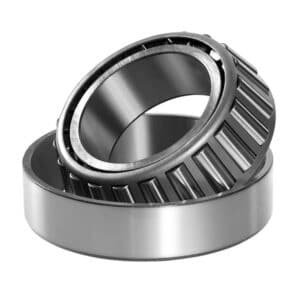
A tapered roller bearing is a rolling-element bearing that uses conical rollers positioned between tapered inner and outer raceways.
The tapered design allows the bearing to handle heavy radial loads along with significant axial (thrust) loads in one direction. For applications requiring axial loads in both directions, two tapered roller bearings are generally installed opposite each other.
How Does a Tapered Roller Bearing Work?
As the shaft rotates, the tapered rollers roll between the inner and outer raceways instead of sliding.
The conical geometry ensures that all rollers meet at a common point on the bearing axis, allowing forces to distribute evenly across the rollers. This improves stability, reduces friction, and enables the bearing to withstand heavy combined loads.
Components of a Tapered Roller Bearing
| Inner Ring (Cone) | Outer Ring (Cup) | Tapered Rollers | Cage (Retainer) | Tapered Raceways |
Advantages & Limitations of Tapered Roller Bearings
| Advantages | Limitations |
|---|---|
| High Radial Load Capacity | Higher Friction Than Ball Bearings |
| High Axial Load Capacity | Moderate Speed Capability |
| Excellent Rigidity | Requires Accurate Mounting |
| Long Service Life | Needs Proper Lubrication |
| Handles Combined Loads | Usually Installed in Pairs for Bidirectional Axial Loads |
| Shock Load Resistant | |
| High Durability | |
| Reliable Performance |
Cylindrical Roller Bearing
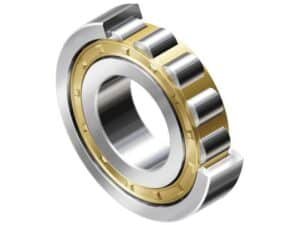
A cylindrical roller bearing is a rolling-element bearing that uses cylindrical rollers as the rolling elements. Unlike ball bearings that use point contact, cylindrical rollers create line contact with the raceways, allowing the bearing to support significantly higher radial loads while maintaining excellent rotational accuracy.
How Does a Cylindrical Roller Bearing Work?
As the shaft rotates, the inner ring rotates along with it while the cylindrical rollers move smoothly between the inner and outer raceways.
The line contact between rollers and raceways distributes the applied load over a larger surface area. This reduces stress concentration, improves load-carrying capability, and allows the bearing to handle heavy radial loads with minimal friction and wear.
Components of a Cylindrical Roller Bearing
| Inner Ring | Outer Ring | Cylindrical Rollers | Cage (Retainer) | Raceways |
Advantages & Limitations of Cylindrical Roller Bearings
| Advantages | Limitations |
|---|---|
| High Radial Load Capacity | Limited Axial Load Capacity |
| High Rigidity | Sensitive to Misalignment |
| Low Friction | Requires Proper Lubrication |
| High-Speed Capability | Higher Cost Than Ball Bearings |
| Long Service Life | Not Suitable for Heavy Combined Loads |
| Excellent Durability | |
| High Efficiency | |
| Easy Maintenance |
How to Select the Right Bearing Type
Choosing the correct bearing is essential for achieving reliable machine performance. The right selection depends on several factors including load type, speed, operating environment, available space, and maintenance requirements.
| Factor | Consideration |
|---|---|
| Load Type | Determine whether the application requires radial load, axial load, or combined load support. |
| Operating Speed | High-speed applications generally require low-friction bearing designs. |
| Operating Conditions | Temperature, contamination, moisture, and vibration affect bearing life. |
| Space Limitations | Bearing size and design must match available installation space. |
| Maintenance Requirements | Proper lubrication and service accessibility impact long-term performance. |
| Service Life | Selecting the correct bearing improves reliability and reduces downtime. |
The most expensive bearing is not always the best choice. The correct bearing is the one that matches the machine’s actual operating conditions. Over-specifying increases cost, while under-specifying leads to premature failure and unexpected downtime. Not sure which type fits your application? Talk to our sourcing engineers for a recommendation.
Common Applications of Bearings
Bearings are used across almost every industry where controlled motion and rotation are required. Their ability to reduce friction and support loads makes them essential components in modern machinery.
| Industry | Applications |
|---|---|
| Automotive | Wheel hubs, transmissions, engines, steering systems |
| Industrial Machinery | Pumps, compressors, gearboxes, production equipment |
| Aerospace | Aircraft systems and precision rotating components |
| Agriculture | Tractors, harvesters, and farming machinery |
| Electrical Equipment | Electric motors, generators, and fans |
| Construction Equipment | Heavy machinery and rotating assemblies |
Why Bearings Are Critical in Modern Manufacturing
A machine’s efficiency depends heavily on how smoothly its moving parts operate. Bearings reduce friction, minimize energy loss, prevent excessive wear, and allow machines to run continuously under demanding conditions.
Without bearings, modern industrial systems would experience higher energy consumption, increased maintenance requirements, shorter service life, and reduced productivity.
Small in size but critical in function — bearings are the hidden components that keep industries moving.
Frequently Asked Questions About Bearing Types
What is the difference between a ball bearing and a roller bearing?
Ball bearings use spherical balls and make point contact with the raceway, making them ideal for high-speed, lighter-load applications. Roller bearings use cylindrical or tapered rollers that make line contact, allowing them to handle much heavier radial loads at somewhat lower speeds.
Which bearing type is best for heavy loads?
Tapered roller bearings and cylindrical roller bearings are generally the best choice for heavy radial and combined loads, since their line-contact design distributes force over a larger surface area than a ball bearing can.
How do I know which bearing to use for my machine?
Base your choice on load type (radial, axial, or combined), operating speed, environmental conditions, available space, and maintenance access. See the selection factors table above, or contact our team for a tailored recommendation.
Types of Bearings: A Complete Guide to Bearing Types and Applications
Almost every machine that involves rotation or motion depends on one critical component — the bearing. Although hidden inside equipment, bearings play a vital role in reducing friction, supporting moving parts, improving efficiency, and extending machine life. In this guide, we break down the main types of bearings — from household appliances to heavy industrial machinery — and how each one keeps equipment running smoothly, reliably, and precisely. For background on the underlying mechanics, see this overview of mechanical bearings on Wikipedia.
Key Takeaways
- Bearings reduce friction and enable smooth movement between machine components.
- Different types of bearings are designed for different requirements such as speed, load capacity, and operating conditions.
- Rolling element bearings provide high efficiency and precision, while plain bearings excel in heavy-load applications.
- Selecting the right bearing type improves machine reliability, reduces maintenance costs, and increases service life.
The Challenge: Controlling Friction in Moving Machines
When industries began developing machines with rotating and moving components, engineers faced a major challenge — friction.
Continuous metal-to-metal contact between moving parts created excessive heat, rapid wear, reduced efficiency, and frequent machine failures. As machines became faster and more powerful, these issues became major obstacles to industrial growth.
To overcome this challenge, engineers introduced the bearing — a revolutionary mechanical component designed to reduce friction, support rotating shafts, and provide smooth, accurate, and reliable movement.
Bearings transformed mechanical engineering by replacing harmful sliding friction with controlled rolling or sliding motion, allowing machines to operate faster, longer, and more efficiently.
What Is a Bearing?
A bearing is a precision-engineered mechanical component that supports rotating or moving parts while minimizing friction between surfaces.
It carries loads, reduces wear, improves motion accuracy, and extends the operating life of machinery. Bearings are widely used in automotive systems, industrial equipment, electric motors, aerospace applications, and manufacturing machinery.
The Two Main Bearing Categories
1. Rolling Element Bearings
Rolling element bearings use balls or rollers between the inner and outer rings to reduce friction. Instead of sliding contact, the rolling elements move smoothly along precision-machined raceways.
They are widely used in high-speed, high-efficiency, and precision applications where low friction and reliable operation are required.
Advantages of Rolling Element Bearings
| Advantage | Benefit |
|---|---|
| Low Friction | Reduces power loss and heat generation |
| High Speed | Suitable for fast rotating applications |
| High Efficiency | Improves machine performance |
| Long Life | Provides reliable operation |
| High Precision | Maintains accurate movement |
| Low Noise | Ensures smooth operation |
| Easy Installation | Simple replacement and maintenance |
2. Plain Bearings (Sliding Bearings)
Plain bearings operate through sliding contact between two surfaces without using rolling elements.
They are commonly used in heavy-load, low-speed, and oscillating applications where simplicity, durability, and shock resistance are important.
Advantages of Plain Bearings
| Advantage | Benefit |
|---|---|
| Simple Design | Easy manufacturing and installation |
| High Load Capacity | Handles heavy mechanical loads |
| Compact Size | Requires less installation space |
| Shock Resistant | Performs well under impact loads |
| Low Cost | Economical solution for many applications |
| Quiet Operation | Produces minimal operating noise |
Common Types of Bearings Explained
Ball Bearing
A ball bearing is a rolling-element bearing that uses hardened steel balls positioned between an inner ring and an outer ring. The balls move inside precision-machined raceways, replacing sliding friction with rolling friction and allowing components to rotate smoothly with minimal resistance.
How Does a Ball Bearing Work?
When the shaft rotates, the inner ring rotates along with it while the outer ring remains fixed inside the housing. The steel balls roll between the two raceways instead of sliding, significantly reducing friction, heat generation, and wear.
A cage (retainer) keeps the balls evenly spaced, ensuring smooth rotation, stable operation, and reliable performance even at high speeds.
Components of a Ball Bearing
| Inner Ring | Outer Ring | Steel Balls | Cage (Retainer) | Raceways | Seal or Shield |
Advantages & Limitations of Ball Bearings
| Advantages | Limitations |
|---|---|
| Low Friction | Limited Axial Load Capacity |
| High-Speed Operation | Lower Load Capacity Than Roller Bearings |
| Smooth & Quiet Running | Sensitive to Misalignment |
| Long Service Life | Requires Proper Lubrication |
| High Efficiency | Not Suitable for Heavy Shock Loads |
| Low Maintenance | Not Suitable for Extremely Heavy-Duty Applications |
| Easy Installation | |
| Cost Effective | |
| Standardized Sizes |
Deep Groove Ball Bearing
A deep groove ball bearing is one of the most widely used rolling-element bearings. It uses hardened steel balls running inside deep, continuous grooves between the inner and outer rings.
The deep groove design allows it to support radial loads and light axial loads in both directions while providing smooth, quiet, and efficient operation.
How Does a Deep Groove Ball Bearing Work?
The inner ring is mounted on the rotating shaft while the outer ring remains fixed inside the housing. As the shaft rotates, the steel balls roll smoothly inside the raceways, replacing sliding friction with rolling friction.
This reduces heat generation, minimizes wear, and allows machines to operate efficiently for longer periods.
Components of a Deep Groove Ball Bearing
| Inner Ring | Outer Ring | Steel Balls | Cage (Retainer) | Raceways | Seal or Shield |
Deep groove ball bearings are popular because they offer an excellent balance between speed, reliability, cost, and availability. This makes them suitable for applications ranging from electric motors and pumps to automotive systems and industrial equipment. Need this bearing type for your project? Browse our deep groove ball bearing catalog.
Advantages & Limitations of Deep Groove Ball Bearings
| Advantages | Limitations |
|---|---|
| Low Friction | Limited Axial Load Capacity |
| High-Speed Operation | Lower Load Capacity Than Roller Bearings |
| Smooth & Quiet Running | Sensitive to Misalignment |
| Long Service Life | Requires Proper Lubrication |
| High Efficiency | Not Suitable for Heavy Shock Loads |
| Low Maintenance | |
| Easy Installation | |
| Cost Effective | |
| Standardized Sizes | |
| Widely Available |
Tapered Roller Bearing
A tapered roller bearing is a rolling-element bearing that uses conical rollers positioned between tapered inner and outer raceways.
The tapered design allows the bearing to handle heavy radial loads along with significant axial (thrust) loads in one direction. For applications requiring axial loads in both directions, two tapered roller bearings are generally installed opposite each other.
How Does a Tapered Roller Bearing Work?
As the shaft rotates, the tapered rollers roll between the inner and outer raceways instead of sliding.
The conical geometry ensures that all rollers meet at a common point on the bearing axis, allowing forces to distribute evenly across the rollers. This improves stability, reduces friction, and enables the bearing to withstand heavy combined loads.
Components of a Tapered Roller Bearing
| Inner Ring (Cone) | Outer Ring (Cup) | Tapered Rollers | Cage (Retainer) | Tapered Raceways |
Advantages & Limitations of Tapered Roller Bearings
| Advantages | Limitations |
|---|---|
| High Radial Load Capacity | Higher Friction Than Ball Bearings |
| High Axial Load Capacity | Moderate Speed Capability |
| Excellent Rigidity | Requires Accurate Mounting |
| Long Service Life | Needs Proper Lubrication |
| Handles Combined Loads | Usually Installed in Pairs for Bidirectional Axial Loads |
| Shock Load Resistant | |
| High Durability | |
| Reliable Performance |
Cylindrical Roller Bearing
A cylindrical roller bearing is a rolling-element bearing that uses cylindrical rollers as the rolling elements. Unlike ball bearings that use point contact, cylindrical rollers create line contact with the raceways, allowing the bearing to support significantly higher radial loads while maintaining excellent rotational accuracy.
How Does a Cylindrical Roller Bearing Work?
As the shaft rotates, the inner ring rotates along with it while the cylindrical rollers move smoothly between the inner and outer raceways.
The line contact between rollers and raceways distributes the applied load over a larger surface area. This reduces stress concentration, improves load-carrying capability, and allows the bearing to handle heavy radial loads with minimal friction and wear.
Components of a Cylindrical Roller Bearing
| Inner Ring | Outer Ring | Cylindrical Rollers | Cage (Retainer) | Raceways |
Advantages & Limitations of Cylindrical Roller Bearings
| Advantages | Limitations |
|---|---|
| High Radial Load Capacity | Limited Axial Load Capacity |
| High Rigidity | Sensitive to Misalignment |
| Low Friction | Requires Proper Lubrication |
| High-Speed Capability | Higher Cost Than Ball Bearings |
| Long Service Life | Not Suitable for Heavy Combined Loads |
| Excellent Durability | |
| High Efficiency | |
| Easy Maintenance |
How to Select the Right Bearing Type
Choosing the correct bearing is essential for achieving reliable machine performance. The right selection depends on several factors including load type, speed, operating environment, available space, and maintenance requirements.
| Factor | Consideration |
|---|---|
| Load Type | Determine whether the application requires radial load, axial load, or combined load support. |
| Operating Speed | High-speed applications generally require low-friction bearing designs. |
| Operating Conditions | Temperature, contamination, moisture, and vibration affect bearing life. |
| Space Limitations | Bearing size and design must match available installation space. |
| Maintenance Requirements | Proper lubrication and service accessibility impact long-term performance. |
| Service Life | Selecting the correct bearing improves reliability and reduces downtime. |
The most expensive bearing is not always the best choice. The correct bearing is the one that matches the machine’s actual operating conditions. Over-specifying increases cost, while under-specifying leads to premature failure and unexpected downtime. Not sure which type fits your application? Talk to our sourcing engineers for a recommendation.
Common Applications of Bearings
Bearings are used across almost every industry where controlled motion and rotation are required. Their ability to reduce friction and support loads makes them essential components in modern machinery.
| Industry | Applications |
|---|---|
| Automotive | Wheel hubs, transmissions, engines, steering systems |
| Industrial Machinery | Pumps, compressors, gearboxes, production equipment |
| Aerospace | Aircraft systems and precision rotating components |
| Agriculture | Tractors, harvesters, and farming machinery |
| Electrical Equipment | Electric motors, generators, and fans |
| Construction Equipment | Heavy machinery and rotating assemblies |
Why Bearings Are Critical in Modern Manufacturing
A machine’s efficiency depends heavily on how smoothly its moving parts operate. Bearings reduce friction, minimize energy loss, prevent excessive wear, and allow machines to run continuously under demanding conditions.
Without bearings, modern industrial systems would experience higher energy consumption, increased maintenance requirements, shorter service life, and reduced productivity.
Small in size but critical in function — bearings are the hidden components that keep industries moving.
Frequently Asked Questions About Bearing Types
What is the difference between a ball bearing and a roller bearing?
Ball bearings use spherical balls and make point contact with the raceway, making them ideal for high-speed, lighter-load applications. Roller bearings use cylindrical or tapered rollers that make line contact, allowing them to handle much heavier radial loads at somewhat lower speeds.
Which bearing type is best for heavy loads?
Tapered roller bearings and cylindrical roller bearings are generally the best choice for heavy radial and combined loads, since their line-contact design distributes force over a larger surface area than a ball bearing can.
How do I know which bearing to use for my machine?
Base your choice on load type (radial, axial, or combined), operating speed, environmental conditions, available space, and maintenance access. See the selection factors table above, or contact our team for a tailored recommendation.