CNC Machining Services: Costs, Capabilities & How to Choose
A CNC machining quote can swing wildly between shops for the same part — and understanding why is how you stop overpaying. The number on the page is built from machine time, material, setup, and finishing, each a lever you can pull. This guide breaks down what CNC machining services actually cost, what drives those costs, and how to choose a shop that gives you value, not just a low hourly rate.
Here’s the headline: CNC machining runs roughly $20 to $130 per hour depending on the machine, and material alone accounts for 30–50% of a typical part’s cost (Hotean, 2025). Once you see how a quote is built, optimizing it — and comparing shops fairly — gets a lot easier.
Key Takeaways
- CNC rates run $20–130/hour: 3-axis mills $35–55, Swiss turning $60–95, 5-axis $75–130 (Hotean, 2025).
- Material is 30–50% of part cost; design complexity can raise cost 200–300% versus a simplified design.
- A quote = machine time + setup + material + finishing — each a lever you can optimize.
- Choose on total project value — capability, DFM support, integrated finishing — not the lowest hourly rate.
What do CNC machining services cover?
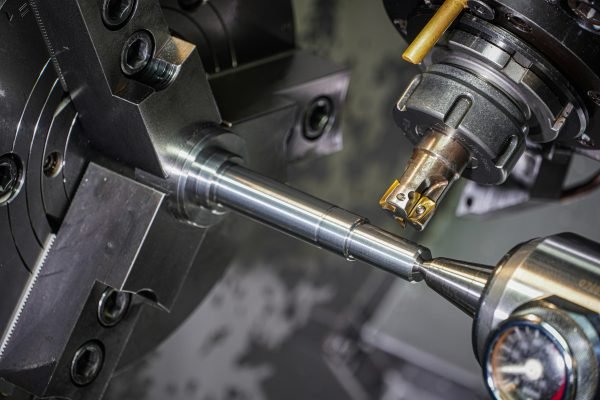
CNC machining is subtractive manufacturing — cutting a part from solid stock using computer-controlled tools. A full-service shop offers a range of processes: 3-, 4-, and 5-axis milling for prismatic parts, turning for cylindrical ones, plus boring, grinding, and EDM for precision features. The more capability under one roof, the fewer vendor hand-offs your part needs.
That breadth matters because most real parts need more than one operation. A shaft might be turned, then milled for a keyway, then ground on its bearing surfaces. A shop that can do all of it in-house cuts lead time, avoids tolerance-stacking between vendors, and keeps a single point of accountability — which is why integrated capability is worth paying attention to.
CNC machining is subtractive manufacturing — cutting parts from solid stock with computer-controlled tools across milling (3/4/5-axis), turning, boring, grinding, and EDM. Most real parts need several operations, so a shop offering integrated capability cuts lead time, avoids tolerance-stacking between vendors, and keeps one point of accountability for your part.
What drives CNC machining cost?
Four factors move a CNC quote more than anything else, and knowing them lets you design and source smarter. Material choice, machining time, setup and programming, and design complexity together explain most of the price difference between parts — and between shops. The table below shows each and how to control it.
| Cost driver | Impact | How to control |
|---|---|---|
| Material | 30–50% of cost + 18–35% markup | Match alloy to function; avoid over-spec |
| Machining time | Biggest variable cost | Simplify geometry, fewer setups |
| Setup & programming | $50–200 setup, $50–150/hr prog | Order in volume to spread it |
| Design complexity | Can add 200–300% | Avoid deep pockets, tiny radii |
| Tolerances | Tighter = slower + more inspection | Tolerance only functional features |
Design complexity is the big, controllable one. Complex geometries, multiple setups, and tight tolerances can raise machining cost 200–300% versus a simplified design. That doesn’t mean compromising function — it means avoiding needless complexity: deep pockets, tiny internal radii, and over-tight tolerances that force slower cutting and extra operations.
Material is the cost lever buyers most underestimate — it’s 30–50% of the part, before an 18–35% markup. Switching a non-critical part from stainless to free-machining aluminum, where the application allows, can halve both the stock cost and the machining time, since aluminum cuts far faster. Always ask whether your material is driven by function or by habit.
CNC machining rates: what you’ll pay
Hourly rate depends mostly on the machine, because a more capable machine costs more to own and run. Basic 3-axis milling is the most economical; multi-axis and Swiss machines command a premium for the complexity they handle. Here’s the 2025 range by machine type.
| 3-axis milling |
| ||
| Swiss turning |
| ||
| 5-axis machining |
|
But don’t fixate on the hourly number — a faster, pricier machine can finish your part in less time and cost less overall. A 5-axis machine that cuts a complex part in one setup may beat a 3-axis shop that needs three setups and more labor. Compare the total part cost, not the rate, and let the shop pick the most efficient machine for the job.
CNC hourly rates track machine capability: 3-axis milling $35–55, Swiss turning $60–95, and 5-axis machining $75–130 per hour. But the hourly rate is misleading on its own — a pricier 5-axis machine that finishes a complex part in one setup often beats a cheaper 3-axis shop needing multiple setups. Compare total part cost, not the rate (Hotean, 2025).
How a CNC quote is built
Every CNC quote assembles from the same four building blocks. Understanding them shows you exactly where your money goes — and where the savings hide. The formula is simple: machine time plus setup plus material plus finishing. Here’s each component in the order it hits your quote.
| # | Stage | What happens |
|---|---|---|
| 1 | Machine time | Hourly rate × machining hours — the biggest variable. |
| 2 | Setup & programming | One-time per job, spread across the quantity. |
| 3 | Material | 30–50% of cost, plus an 18–35% markup. |
| 4 | Finishing / assembly | Plating, anodizing, deburring, or assembly as needed. |
Two components scale differently, which matters for your order size. Setup and programming are largely one-time — spread across the quantity, they shrink per part as volume rises. Material and machine time are per-part and stay roughly constant. That’s why a prototype costs so much more per unit than a production run, and why volume commitments earn real discounts.
How to reduce CNC machining cost
- Simplify geometry — avoid deep pockets, tiny radii, and features needing special tooling.
- Loosen non-critical tolerances — tight limits only where function demands them.
- Choose machinable material — match to function; aluminum cuts far faster than stainless.
- Order in volume — spread setup and programming across more parts.
- Use one integrated shop — avoid vendor hand-offs, freight, and tolerance stacking.
How do you choose a CNC machining supplier?
The cheapest hourly rate rarely means the cheapest part — or the best partner. A good CNC supplier brings capability breadth, real tolerance capability (not just optimistic quotes), design-for-manufacture input, and integrated finishing. Weigh these against price, and judge on total project value. The signals below help you tell a strong shop from a risky one.
| What to look for | Signal |
|---|---|
| Broad in-house capability | ✔ Strong |
| Proven tolerance capability (Cpk) | ✔ Strong |
| Design-for-manufacture feedback | ✔ Strong |
| Lowest hourly rate, nothing else | ✘ Weak |
| Vague on tolerances held | ✘ Weak |
| No inspection or certifications | ✘ Walk away |
The best CNC suppliers save you money before machining starts — through DFM feedback. A shop that reviews your drawing and says “relax these three tolerances and round this pocket, and we’ll cut cost 20%” is worth more than one that simply quotes low and machines exactly what you drew. Design input is where the real savings live, not the hourly rate.
Machined parts with capability behind them — from Rajkot to the world
Great CNC sourcing is about value, not the lowest rate. Magnus Sourcing connects global buyers to Rajkot’s multi-axis machining shops — milling, turning, boring, grinding, and EDM — with design-for-manufacture input, CMM inspection, and finishing under one accountable partner. Our supplier network holds ISO 9001:2015 and IATF 16949 standards, with material traceability. See our CNC machining capability.
Need machined parts done right and priced fairly? Send us your drawing and volume, and our engineering team will quote it — with DFM feedback to cut cost where it won’t hurt function.
Made in India. Trusted Globally.
Frequently Asked Questions
How much does CNC machining cost per hour?
CNC machining runs about $20–130 per hour depending on the machine: 3-axis mills $35–55, Swiss turning $60–95, and 5-axis machining $75–130. But hourly rate alone is misleading — a faster, pricier machine can finish a part in less time and cost less overall, so compare total part cost (Hotean, 2025).
What is the biggest cost in CNC machining?
Material and machine time dominate. Material alone accounts for 30–50% of a typical part’s cost, before an 18–35% markup. Machining time — driven by design complexity, setups, and tolerances — is the other major factor. Design complexity can raise cost 200–300% versus a simplified part.
How can I reduce my CNC machining cost?
Simplify geometry, loosen non-critical tolerances, choose a machinable material matched to function, order in volume to spread setup costs, and use one integrated shop to avoid vendor hand-offs. Design-for-manufacture changes often cut 20% or more before you even negotiate the quote.
Is a 5-axis machine always more expensive?
The hourly rate is higher ($75–130 vs $35–55 for 3-axis), but the total cost can be lower. A 5-axis machine that cuts a complex part in a single setup may beat a 3-axis shop needing multiple setups and more labor. For complex parts, 5-axis often delivers the lower total cost.
How do I choose a CNC machining supplier?
Judge on total project value, not the lowest hourly rate. Look for capability breadth, genuine tolerance capability, design-for-manufacture input, integrated finishing, and quality certifications like ISO 9001. A supplier who improves your design and quotes honestly beats one who simply quotes low and machines exactly what you drew.
The bottom line
CNC machining cost isn’t a mystery once you see its parts: machine time, material, setup, and finishing, each a lever you can pull. Simplify design, tolerance smartly, choose material by function, and order in volume, and you cut cost without hurting the part. Then choose a supplier on total value and DFM support — not the lowest hourly rate — and you get machined parts that are both right and right-priced.
Sourcing machined parts from India? Magnus Sourcing’s Rajkot shops combine multi-axis capability with DFM feedback and inspection under one partner. Start with a free machining quote →