Die Casting vs Investment Casting: How to Choose
Both make precise metal parts. Both are called “casting.” But die casting and investment casting sit at opposite ends of the sourcing map — one built for high-volume aluminum and zinc, the other for complex parts in almost any alloy. Choose wrong and you either can’t make the part at all, or you pay far too much. Here’s how to choose right.
The decision usually comes down to three things: your material, your volume, and your geometry. Die casting dominates high-volume non-ferrous production with fast cycles and tight tolerances; investment casting wins on complex shapes and a far wider alloy range, including steel and superalloys (Dynacast, 2025). Get those three factors straight and the answer is usually obvious.
Key Takeaways
- Die casting forces metal into a reusable steel mold under pressure — unbeatable for high-volume aluminum and zinc parts (Dynacast, 2025).
- Investment casting pours into an expendable ceramic shell — ideal for complex geometry and a wide alloy range, including steel and superalloys.
- Tolerances: die casting holds ±0.15–0.3% of nominal; investment casting ±0.3–0.5%; die casting edges it on non-ferrous.
- Volume decides cost: die casting’s high tooling pays off in the tens of thousands; investment casting suits low-to-mid volumes.
What’s the core difference between the two?
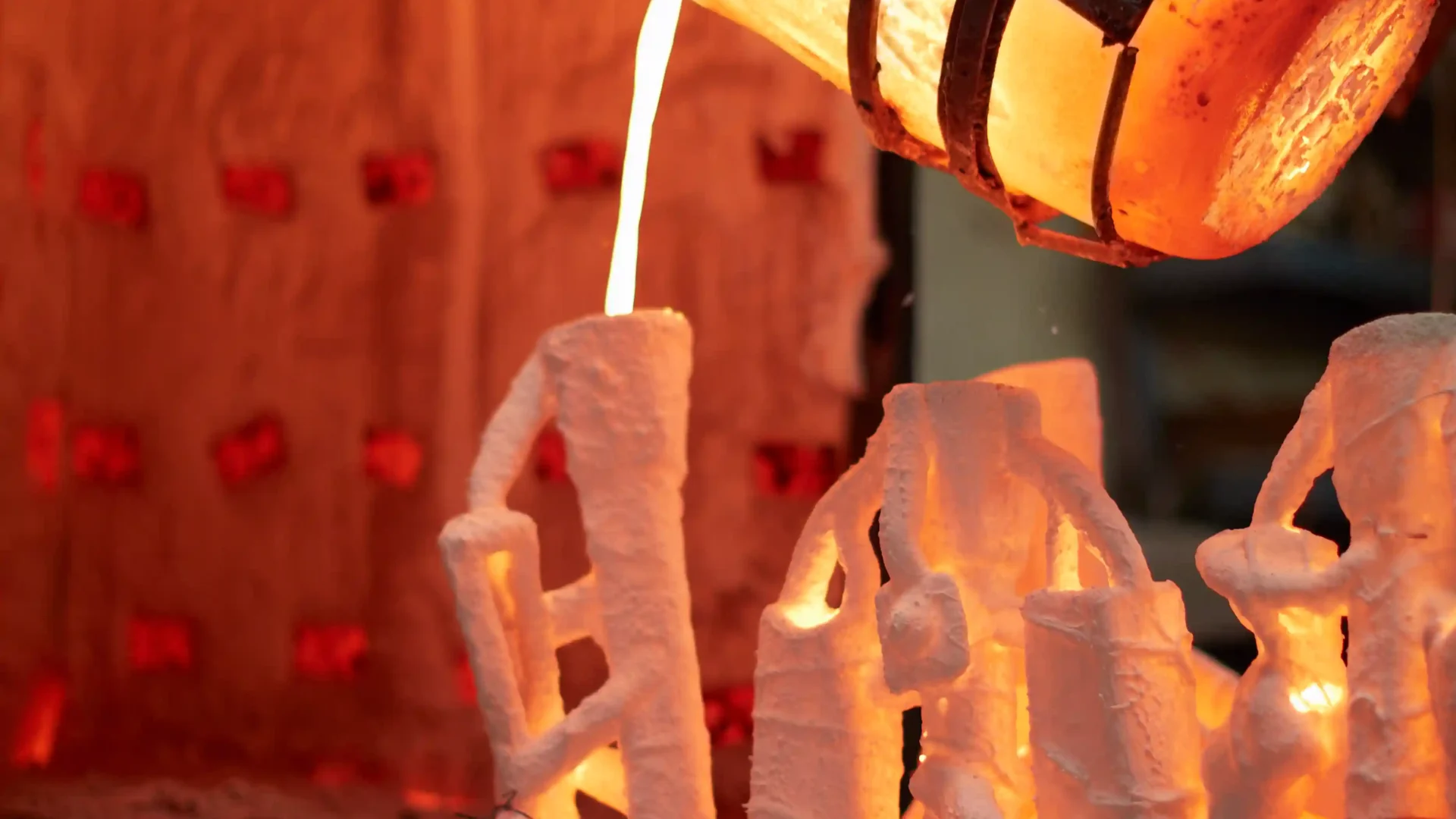
The split is mold type and how metal enters it. Die casting injects molten metal under high pressure into a reusable hardened-steel mold (the die), which snaps open to eject the part and cycles again in seconds. Investment casting pours metal by gravity into a one-piece ceramic shell built around a wax pattern — a mold that’s destroyed to release each part.
That single difference cascades into everything else. The reusable steel die makes die casting fast and cheap per part at scale, but limits it to lower-melting non-ferrous metals that won’t destroy the die. The expendable ceramic shell makes investment casting slower and more labor-intensive, but able to handle high-melting alloys and intricate geometry the die could never form.
Die casting injects molten metal under pressure into a reusable steel die, cycling in seconds; investment casting pours into an expendable ceramic shell destroyed to release each part. The reusable die makes die casting fast and cheap at scale but limits it to non-ferrous metals, while the ceramic shell lets investment casting handle high-melting alloys and complex geometry (RapidDirect, 2025).
Which is more precise?
Both are precision processes, but die casting holds slightly tighter tolerances on the parts it can make. Die casting typically achieves ±0.15–0.3% of nominal dimension, and zinc die casting can reach an exceptional ±0.0015″ per inch. Investment casting runs ±0.3–0.5% — excellent, and across a much wider range of alloys and shapes (Manufyn, 2025).
| Die casting |
| ||
| Investment casting |
| ||
| Sand casting (context) |
|
The nuance is what each precision applies to. Die casting’s tight tolerance comes on relatively simple, uniform-wall aluminum and zinc parts. Investment casting delivers its precision on genuinely complex geometry — internal passages, intricate detail, thin features — and in steel, stainless, and superalloys that die casting simply can’t touch. So “more precise” depends entirely on which part you’re making.
Die casting holds ±0.15–0.3% of nominal (zinc reaches ±0.0015″ per inch), slightly tighter than investment casting’s ±0.3–0.5%. But die casting’s precision applies to simpler non-ferrous parts, while investment casting delivers comparable accuracy on complex geometry across steel, stainless, and superalloys — so the “more precise” process depends on the part (Manufyn, 2025).
Which handles complex geometry and materials?
Investment casting wins decisively on both. Its expendable ceramic shell forms intricate shapes, internal cavities, undercuts, and fine detail that a two-piece steel die can’t release. And it casts an enormous alloy range — carbon and alloy steel, stainless, aluminum, bronze, and high-temperature nickel and cobalt superalloys.
Die casting is far more constrained on both counts. Geometry must allow the part to eject from a rigid steel die, so deep undercuts and complex internal passages are difficult or impossible. And because molten metal would erode the steel die, die casting is limited to non-ferrous metals — mainly aluminum, zinc, and magnesium. If your part needs steel or a superalloy, investment casting isn’t just better; it’s the only option.
The material question often ends the debate before cost or volume enters it. We regularly see buyers weighing “die vs investment” for a stainless-steel part — but die casting can’t make ferrous parts at all. If your alloy is steel, stainless, or a superalloy, you’re choosing investment casting (or forging), full stop. Confirm the material constraint first; it saves a lot of wasted analysis.
Cost and volume: the real deciding factor
For parts both processes can make — aluminum and zinc — cost comes down to volume. Die casting carries expensive tooling: hardened steel dies run $20,000 to well over $100,000. But those dies last a long time (a zinc die can exceed two million shots), and cycle times are seconds, so per-part cost collapses at high volume.
Investment casting has lower tooling (a wax-injection die) and no per-part die wear, but it’s labor-intensive with slow cycles, so per-part cost stays higher and doesn’t fall as steeply with volume. The result: die casting wins big in the tens of thousands and up; investment casting wins at low-to-mid volumes, or whenever the part or alloy rules die casting out entirely.
When we model aluminum parts that both processes could make, the crossover usually lands somewhere in the low tens of thousands of units per year. Below that, investment casting’s lower tooling wins; above it, die casting’s fast cycle and cheap piece price dominate. But remember — this comparison only exists for non-ferrous parts. For steel, there’s no crossover to model.
Die casting vs investment casting: side by side
Here’s the full comparison in one view. Read down your priority — material, volume, geometry, tolerance — and the right process usually jumps out. Notice how rarely the two actually compete: they mostly serve different parts entirely.
| Factor | Die casting | Investment casting |
|---|---|---|
| Mold | Reusable steel die | Expendable ceramic shell |
| How metal enters | High-pressure injection | Gravity pour |
| Materials | Non-ferrous only (Al, Zn, Mg) | Wide (steel, SS, Al, superalloy) |
| Tolerance | ±0.15–0.3% | ±0.3–0.5% |
| Surface finish | Very smooth (Ra 1–3 µm) | Smooth (Ra 1.6–6.3 µm) |
| Geometry | Must eject from die | Very complex, internal cavities |
| Tooling cost | High ($20k–$100k+) | Moderate (wax die) |
| Best volume | Very high (10k+) | Low-to-mid |
| Cycle time | Seconds | Slow, labor-intensive |
Die casting and investment casting rarely compete head-to-head: die casting serves high-volume non-ferrous parts with fast cycles and low piece cost, while investment casting serves complex geometry and the full alloy range including steel and superalloys at low-to-mid volume. The choice is usually settled by material and volume before tolerance or finish enter the discussion (Dynacast, 2025).
So which should you choose?
Work through it in order: material, then volume, then geometry. If your part is steel, stainless, or a superalloy, choose investment casting. If it’s aluminum or zinc, ask about volume — tens of thousands point to die casting, smaller runs to investment casting. Then let geometry break any remaining tie: complex and intricate favors investment casting; simple and uniform favors die casting. The map below sums it up.
| Your requirement | Better choice |
|---|---|
| Steel, stainless, or superalloy | Investment casting |
| High volume (10k+) of Al / Zn | Die casting |
| Complex geometry, internal detail | Investment casting |
| Fastest cycle, lowest piece price | Die casting |
| Low-to-mid volume precision part | Investment casting |
| Tight tolerance on non-ferrous | Die casting |
Cast it right, whichever process fits — from Rajkot to the world
The best process depends on your part — so you want a partner who runs both. Magnus Sourcing connects global buyers to Rajkot foundries offering die casting and investment casting side by side, plus machining and finishing under one accountable partner. Our supplier network holds ISO 9001:2015, IATF 16949, and AS9100 standards, with full traceability and US import-compliant documentation.
Not sure which process your part needs? Send us your drawing, material, and target volume — our engineering team will recommend die casting, investment casting, or an alternative, with a should-cost estimate.
Get a free process recommendation →
Made in India. Trusted Globally.
Frequently Asked Questions
Can die casting be used for steel parts?
No. Die casting is limited to non-ferrous metals — mainly aluminum, zinc, and magnesium — because molten steel would erode the hardened-steel die. For steel, stainless, or superalloy parts, investment casting (or forging) is the right route. This material constraint often decides the choice before anything else.
Which is cheaper, die casting or investment casting?
For aluminum and zinc parts, it depends on volume. Die casting has high tooling ($20k–$100k+) but very low piece cost, so it wins at high volumes (tens of thousands). Investment casting has lower tooling and suits low-to-mid volumes. For ferrous parts, only investment casting applies (RapidDirect, 2025).
Which process holds tighter tolerances?
Die casting holds slightly tighter tolerances — ±0.15–0.3% of nominal, with zinc reaching ±0.0015″ per inch — versus investment casting’s ±0.3–0.5%. But die casting’s precision applies only to simpler non-ferrous parts, while investment casting delivers its accuracy on complex geometry and a far wider alloy range.
Which is better for complex shapes?
Investment casting. Its expendable ceramic shell forms intricate geometry, internal passages, undercuts, and fine detail that a rigid two-piece steel die can’t release. Die casting requires geometry that ejects cleanly from the die, limiting complexity. For genuinely intricate parts, investment casting is the clear choice.
How long do die-casting molds last?
A long time, which is central to their economics. Zinc die-casting molds can exceed two million shots; aluminum molds are lower but still very high. This longevity spreads the high tooling cost across huge volumes, driving per-part cost down — the reason die casting dominates high-volume non-ferrous production.
The bottom line
Die casting and investment casting aren’t really rivals — they’re specialists. Die casting owns high-volume aluminum and zinc parts with fast cycles and rock-bottom piece cost. Investment casting owns complex geometry and the full alloy range, including the steels and superalloys die casting can’t touch. Decide by material first, then volume, then geometry, and the right process picks itself.
Still weighing it for a specific part? Magnus Sourcing runs both processes from Rajkot and will recommend the right one — backed by should-cost estimates and IATF/AS9100-grade quality. Start with a free process review →